Why the next category in enterprise software isn’t a better HR tool, it’s a new operating layer.
Every technology category is born the same way: a problem gets too expensive to ignore, fragmented tools prove unable to solve it, and a new architectural concept emerges to replace them. ERP unified accounting, procurement, and supply chain. CRM unified sales, marketing, and customer data. The same convergence is now happening in how organizations manage people and performance, and the category that will define the next decade already has a name: The People & Performance Management Operating System.
This isn’t a rebrand of HR software. It’s a structural response to a structural problem.
At Twiser, we’ve spent years watching organizations struggle with the same structural failure: great strategy that never reaches the team level, performance cycles disconnected from how work actually flows, competency frameworks that exist in slide decks but never touch daily decisions, and AI investments that capture a fraction of their potential because the underlying management system wasn’t designed to hold them together.
That failure has a name too: an architecture problem. And the People & Performance Management OS is the answer.
The Problem Hiding Inside Every “High-Performing” Organization
Ask any CHRO whether their organization has a performance management system. The answer is always yes. Ask whether that system connects goals to competencies, competencies to learning, learning to development, and all of it to the daily rhythm of how work actually gets done. The answer, almost universally, is no.
Gartner’s 2026 CHRO priorities research puts it bluntly: organizations are managing HR as a collection of separate processes rather than an integrated operating system. Goals live in one tool. Performance reviews live in another. Learning platforms are disconnected from competency frameworks. Employee engagement scores sit in a dashboard that no one checks between annual surveys.
The result is what PMI’s research calls the “strategy-execution gap”, the persistent, measurable distance between what organizations plan and what actually happens at the team level. PMI’s findings show that strategic goals routinely fail to translate into project execution, that performance metrics are misaligned with strategy, and that human performance stays disconnected from the actual work being done. This isn’t a people problem. It’s an architecture problem.
Three Converging Forces Making the Old Architecture Obsolete
Three independent lines of research, from Gartner, Harvard Business Review, and Josh Bersin, converged on the same conclusion in 2025–2026: the pyramid org chart, the annual performance cycle, and the siloed HR tool stack were designed for a world that no longer exists. Three organizational models are replacing them.
Harvard’s Project-Driven Organization (HBR, January 2026) shows that strategy is no longer executed through functional hierarchies — it’s executed through project portfolios. Value is created in end-to-end project streams, not in functional silos. Resources move between projects. Teams are temporary but aligned. This means performance and competency management can’t be anchored to static job descriptions anymore; they need to follow the actual flow of work.

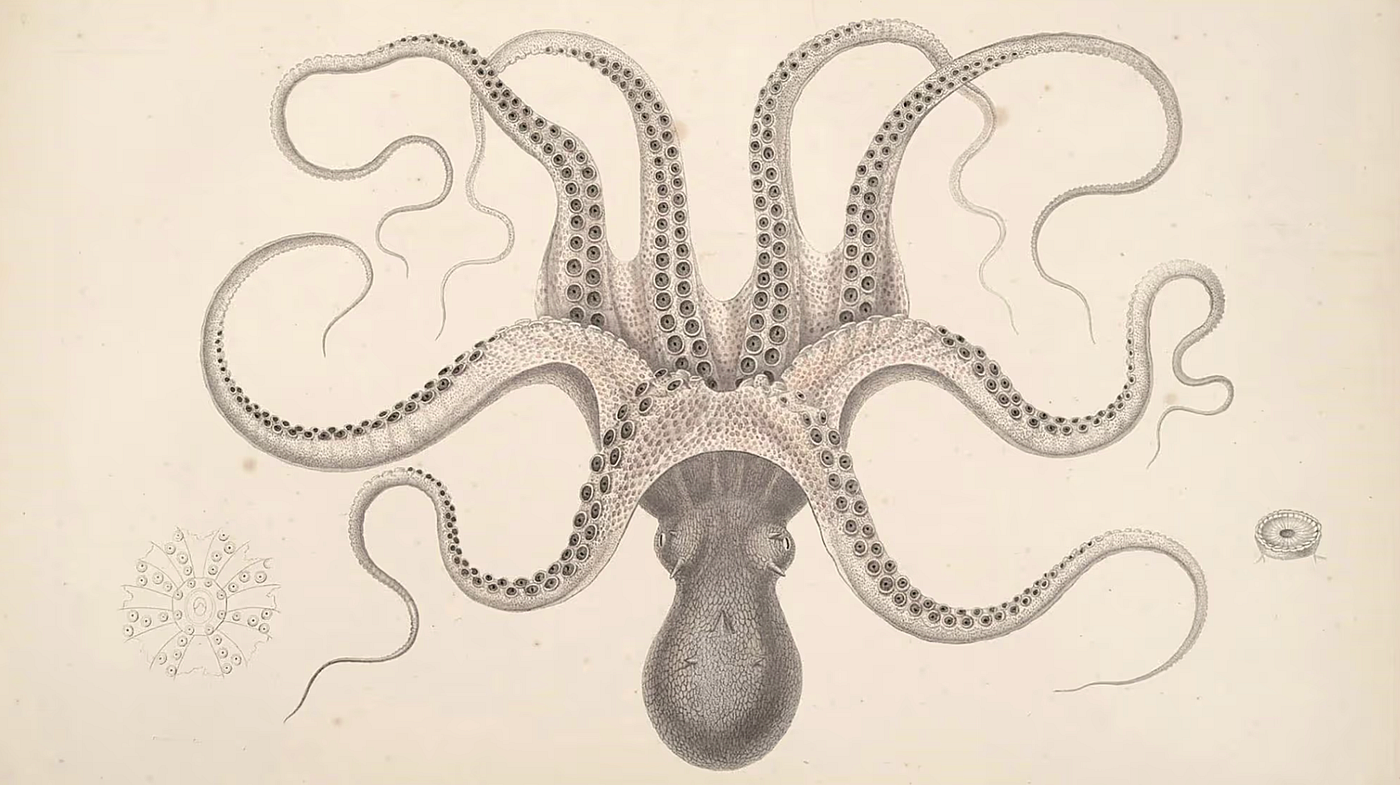
Harvard’s Octopus Organization (HBR, November 2025) describes a shift from centralized hierarchy to a distributed network where intelligence is spread across the entire organization. Small, semi-autonomous teams operate with local autonomy and global alignment. Decision rights move to the edges. Leadership transforms from command-and-control to orchestration. In this model, performance management systems that cascade slowly from the top are not just inefficient — they’re structurally incompatible with how the organization actually operates.
Josh Bersin’s Superworker Organization captures the AI dimension: as AI agents take over end-to-end workflows, value no longer comes from individual roles but from the intelligent systems of human + AI collaboration. Performance emerges from the effectiveness of those collaborative systems, not from individual task completion. The unit of measurement shifts from the person to the workflow.
When you overlay these three models, a clear architectural requirement emerges: organizations need a management layer that unifies goals, performance, competency, learning, and employee experience — and makes all of it flow in a single operational rhythm across projects, workflows, and teams. That layer is what we call the People & Performance Management Operating System. That layer is Twiser.
Why AI Makes This Urgent, Not Optional
Josh Bersin’s research on AI maturity describes four stages of organizational AI adoption.
Stage 1 (AI Assistants) produces 15–30% productivity gains by helping individuals work faster within existing roles.
Stage 2 (AI Agents) reaches 30–50% by eliminating steps in existing workflows.
Stages 3 and 4 (Cross-functional superagents and autonomous agents) unlock 100–200% and 300%+ productivity gains, respectively, but only when organizations redesign work at the architectural level: new roles, new workflows, new definitions of what performance even means.
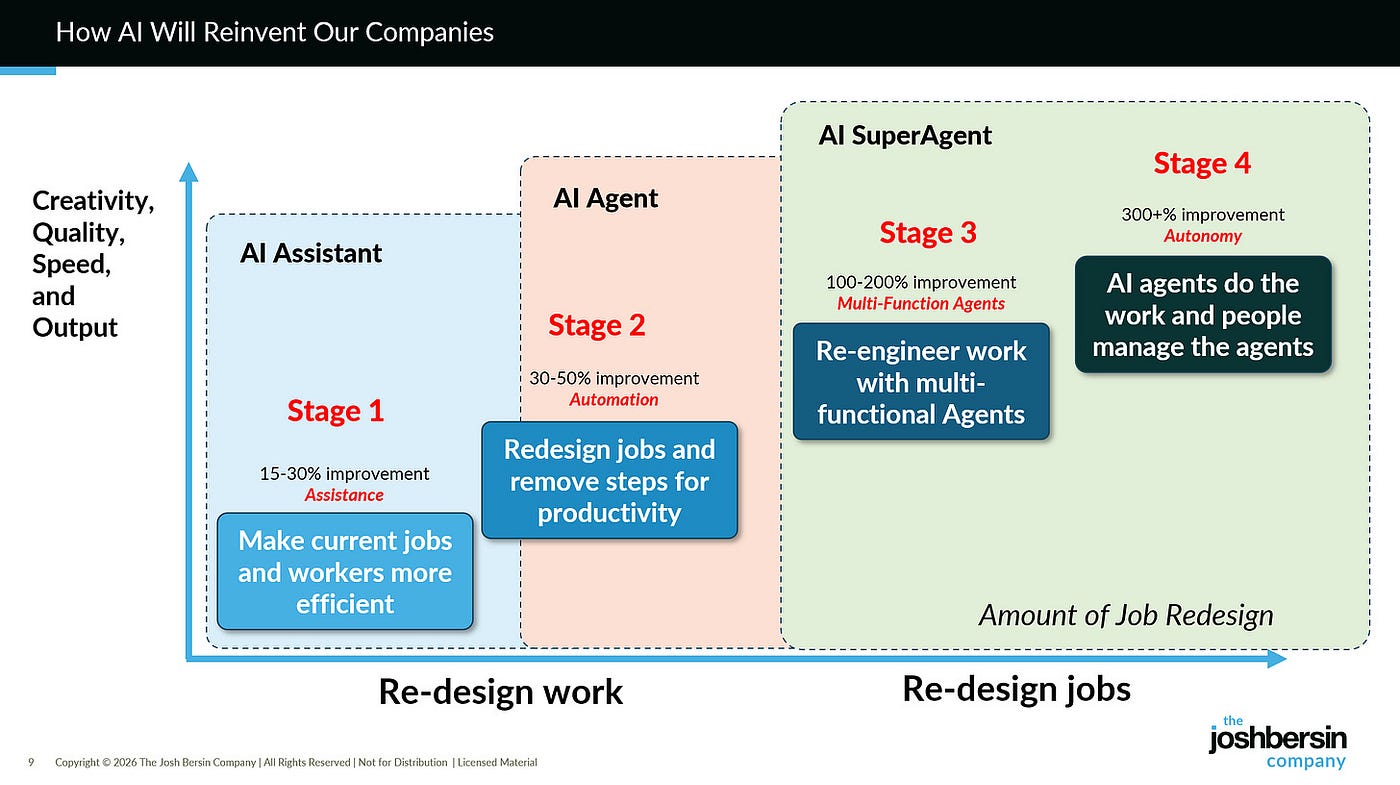
Most organizations are still in Stage 1–2. The gap between what AI can theoretically do and what organizations are actually capturing is enormous. Anthropic’s March 2026 labor market research introduced a metric for this: Observed Exposure — the gap between AI’s theoretical capability and its actual use in professional settings. In computer and mathematics roles, AI can theoretically handle 94% of tasks. Current professional adoption sits at 33%. In legal and administrative work, theoretical capacity is 80%; actual use is below 30%.
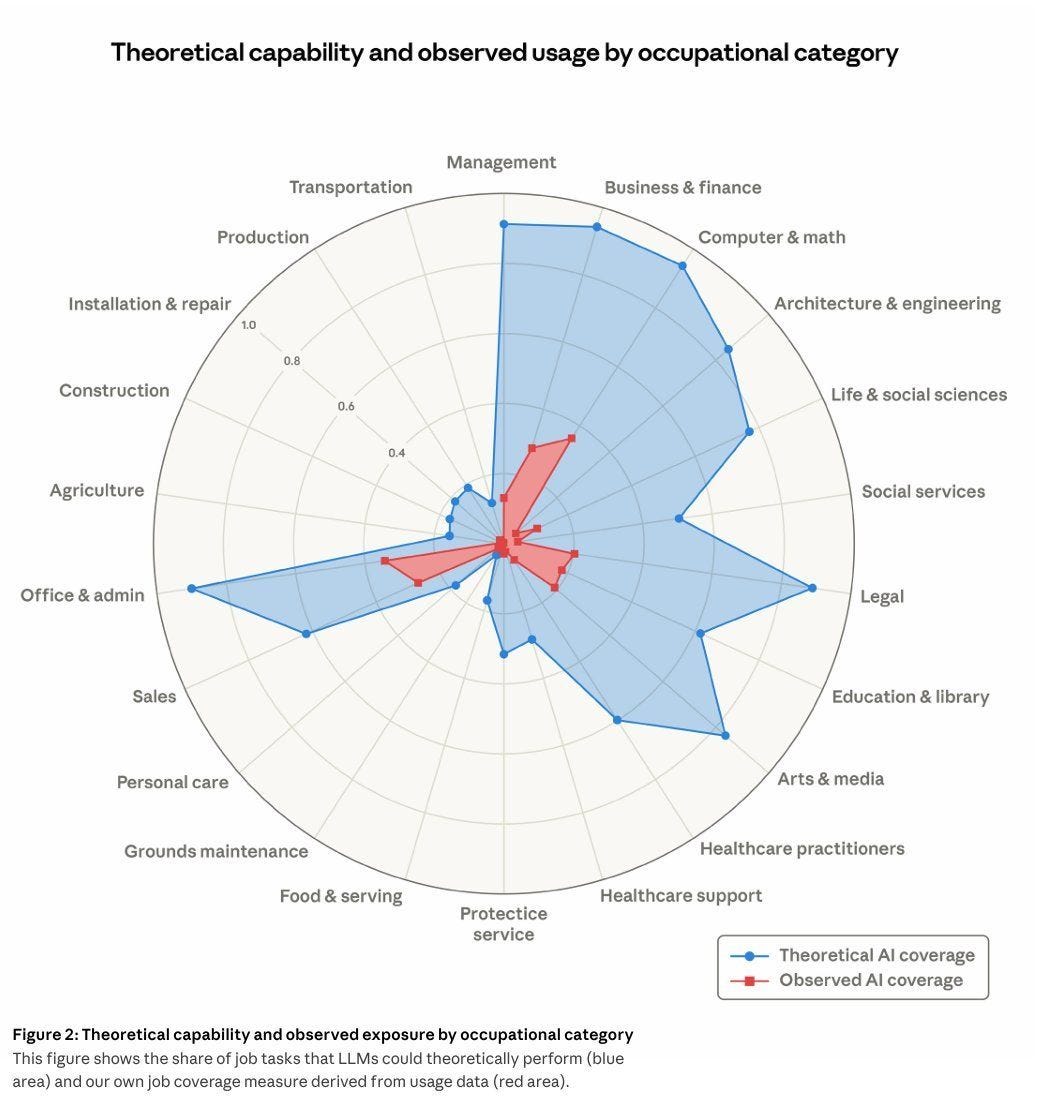
The reason for this gap, as Bersin and Gartner both identify, is not technical. It’s organizational. Companies are layering AI tools onto old workflows, old role definitions, and old decision structures. Jonathan Brill’s concept of organizational debt names this precisely: the accumulated cost of management structures, approval processes, and role architectures that made sense for a pre-AI world but now create drag rather than leverage.
The critical insight here is what Gartner’s 2026 CHRO research confirms: AI creates value not when it automates tasks, but when it enables organizations to redesign work at the system level. The question is no longer “Where are we using AI?” The question is “To what degree has our people and performance system been redesigned around AI-era workflows?”
That redesign requires an operating system — not a collection of tools.
The Hidden Cost of Productivity: Work Intensification
There’s a paradox at the heart of AI adoption that most organizations are not yet measuring.
Harvard Business Review’s February 2026 study, “AI Doesn’t Reduce Work — It Intensifies It,” tracked 40 employees across engineering, product, design, and operations at a 200-person tech company for eight months. The finding is counterintuitive: AI-enabled employees did not work less. They worked faster, took on a broader scope, and extended work into more hours of the day — voluntarily, because AI made “doing more” feel possible.
Three mechanisms drive this: task expansion (AI makes new tasks accessible, so workers take them on), blurred work-life boundaries (small amounts of work slip into moments that used to be off-hours), and cognitive multitasking (managing multiple AI agents simultaneously increases mental load rather than reducing it).
The implication is significant. Without a system that connects workload, performance expectations, competency development, and employee well-being in a coherent architecture, AI amplification becomes a hidden tax on human capacity rather than a genuine force multiplier. The WEF Future of Jobs Report 2025 projects that nearly 40% of the skills required on the job will change by 2030 — and the organizations that navigate this without burning out their workforce will be those with integrated people and performance systems, not just better tools.
The Meaning Crisis That Performance Systems Are Ignoring
There is a human dimension to this problem that data makes impossible to dismiss.
HRdergiLAB’s 2026 Meaning at Work Research, conducted across 9,500 employees in Turkey, produced a national meaning-at-work score of 52 out of 100 — defined as “a working experience at the threshold of disengagement.” This is not an active resignation. It is something more dangerous: employees who remain in the system but have withdrawn their emotional and cognitive investment.
The research identifies four structural weaknesses driving this score: psychological safety that is inconsistent and leader-dependent; discontinuous recognition systems (employees feel their contributions go unacknowledged); work-life balance treated as a privilege rather than as an infrastructure for sustained performance; and leadership focused on managing work rather than on generating meaning.
92% of participants identified work-life balance as a foundational prerequisite for finding meaning at work. 86% said it was “very” or “extremely” important that their work creates a meaningful impact.
The Twiser perspective on this data: meaning is not an individual emotion. It is a system output. Meaning emerges — or fails to emerge — from how goals, performance expectations, development paths, competencies, and employee experience are aligned with each other. When these operate in separate systems, on separate rhythms, with separate data, meaning cannot be designed. It can only be hoped for.
Designing meaning at scale requires an OS. That is exactly what Twiser builds.
A People & Performance Management OS is the architectural prerequisite for making meaning designable.
What a People & Performance Management OS Actually Is
The concept requires a clear definition, because it is easy to misread as a feature upgrade to existing HR software. It isn’t.
Twiser’s People & Performance Management OS is an integrated management layer — an orchestration layer — that unifies goals (OKRs/KPIs), performance management, competency architecture, learning and development (LMS/LXP), and employee engagement under a single operational rhythm. It does not replace these functions. It connects them, makes them coherent, and makes data flow between them in real time.
The operative principle is what we call One Rhythm: goals, performance cycles, competency development, learning progress, and employee experience should not operate on separate calendars, platforms, or reporting chains. They should move in a single integrated rhythm — because in practice, they are not separate phenomena. They are the same phenomenon observed from different angles.
The architecture supports this through a Lens-Based Model: organizations can enter the system through the dimension most urgent to them — goal-setting, performance management, competency mapping, learning, or engagement — and expand from there as their processes mature. This avoids the big-bang implementation trap that has caused so many HR technology transformations to fail.
The AI layer within a People & Performance Management OS operates across four capabilities: OKR Quality Control (ensuring goals are genuinely measurable and strategically aligned, not just formally documented), Predictive Insights (surfacing organizational risks and development needs before they become visible performance problems), Objective Calibration (bringing consistency and evidence-basis to performance evaluations), and Manager as Coach (enriching 1:1 conversations, feedback, and development dialogues with real data rather than intuition).
This is the difference between AI as a tool and AI as a management layer. This is the difference between an HR platform and an operating system.
The Manager Role Has to Change — Which Means the System Has to Change
Gartner’s research on what Bersin calls the Supermanager describes a shift already underway in high-performing organizations: managers are moving from performance monitoring and process oversight toward a fundamentally different role — interpreting data, identifying opportunities, and orchestrating human + AI capacity to produce organizational outcomes.
The practical competency requirements for this new role are clear: data literacy (interpreting AI-generated insights and distinguishing meaningful signals from noise), decision literacy (knowing which decisions require human judgment and which can be system-supported), workflow thinking (designing work as flows rather than tasks), ethical reasoning (evaluating AI-assisted decisions for risk and bias), and redesign capability (restructuring roles, workflows, and performance architectures as the operating environment changes).
None of these competencies can be developed — or exercised — in a system where performance, learning, competency, and goals are managed separately. The Supermanager needs integrated data flowing in real time. That requires an operating system, not a spreadsheet and four separate platforms.
The Category Is Being Created — Twiser Is Creating It.
Category creation in enterprise software follows a recognizable pattern. It begins with a convergence of external signals — research from analysts, academics, and practitioners pointing toward the same structural gap. Then a company names the category, defines its architecture, and builds the market around that definition.
The signals converging around People & Performance Management as an operating system category are now unmistakable:
- Gartner’s modern HR operating model — performance must be designed organization-wide, not managed as isolated processes
- Harvard’s project-driven organization framework — strategy executes through workflows and projects, not hierarchies
- Harvard’s octopus organization model — intelligence distributed across autonomous teams requires global alignment without central control
- Bersin’s superworker organization — AI-era performance emerges from human + AI system effectiveness, not individual output
- Anthropic’s labor market research — the gap between AI capability and organizational capture is an architecture problem
- HBR’s work intensification findings — AI amplification without integrated people systems creates cognitive debt, not sustainable productivity
All of them point to the same missing layer.
The organizations that will win the next decade of talent competition are not those that find better tools for each HR function. They are those that redesign people and performance management as a unified operating system — one that works the way their organizations actually work: in workflows, in projects, in human + AI collaboration, in real time.
The People & Performance Management OS is not the future of HR technology. It is the operating layer that enables future organizational performance.
What This Means for CHROs and People Leaders Right Now
Five diagnostic questions make the architecture gap concrete:
- When a strategic goal is set at the executive level, how many steps and systems does it take before it translates into a clear individual development focus?
- Can you see, in real time, whether the competencies being developed across the organization match the competencies your strategy requires over the next 12–24 months?
- When a manager wants to have a meaningful 1:1 conversation about an employee’s growth, do they have integrated data — or are they working from memory and intuition?
- Can you measure the strategy-execution gap — the distance between what you planned and what actually happened at team level — and trace its causes?
- If AI handles 30% of current workflow volume in the next 18 months, does your performance architecture tell you what that means for how you define, measure, and develop human performance?
If the honest answer to most of these is “no” or “not really,” the architecture gap is real. And the cost — in strategy that fails to execute, in talent that exits silently, in AI investments capturing a fraction of their potential value — is compounding every quarter.
The People & Performance Management Operating System is the answer to that gap. It is a category being created by research converging from multiple directions, by organizational pressures that are no longer deferrable, and by the companies that choose to build their management architecture for the world as it is becoming.
Twiser is the People & Performance Management OS unifying goals, performance, competency, learning, and employee engagement in One Rhythm for organizations building for sustainable growth. www.twiser.com
This article draws on findings from Twiser Insights Series 1, 2, and 3 (February‚ April, and May 2026) — our ongoing research initiative on people and performance management. Explore the full series and request a demo at twiser.com
info@twiser.com